本试卷分第一卷(选择题)和第二卷(非选择题)两部分。第一卷1至14页。第二卷1至4页。共150分。考试时间120分钟。
第一卷(三大题,共95分)
注意事项:
1.答第一卷前,考生务必将自己的姓名、准考证号、考试科目用铅笔涂写在答题卡上。
2.每小题选出答案后,用铅笔把答题卡上对应题目的答案标号涂黑。如需改动,用橡皮擦干净后,再选涂其 他答案标号。不能答在试卷上。
3.考试结束,考生将本试卷和答题卡一并交回。
Ⅰ.单项填空(共25小题,每小题1分;满分25分)
A)从A、B、C、D中找出其划线部分与所给单词的划线部分读音相同的选项。
例:have
A. gave B. save C. hat D. made
答案是C。
1.spare
A. fear B. earn C. pear D. beard
2.navy
A. neighbor B. nationality C. relative D. valley
3.unit
A. fierce B. nephew C. juice D. sure
4.gentle
A. organise B. bargain C. regular D. charge
5.journey
A. merchant B. courtyard C. energy D. serious
B)从A、B、C、D四个选项中,选出可以填入空白处的最佳答案。
例:We _______ last night, but we went to the concert instead.
A. must have studied B. might study
C. should have studied D. would study
答案是C。
6.—I had a really good weekend at my uncle‘s.
—__________.
A. Oh, that’s very nice of you
B. Congratulations
C. It‘s a pleasure
D. Oh, I’m glad to hear that
7.—I‘m going to the post office.
—________ you’re there, can you get me some stamps?
A. As B. While
C. Because D. If
8.Paper money was in _______ use in China when Marco Polo visited the country in __________ thirteenth century.
A. the;不填 B. the;the
C. 不填;the D.不填;不填
9.—Are the new rules working?
—Yes. _________ books are stolen.
A. Few B. More
C. Some D. None
10.—Alice, you feed the bird today, __________?
—But I fed it yesterday.
A. do you B. will you
C. didn‘t you D. don’t you
11.________, you‘ve got a chance, you might as well make full use of it.
A. Now that B. After
C. Although D. As soon as
12.________ him and then try to copy what he does.
A. Mind B. Glance at
C. Stare at D. Watch
13.—I drove to Zhuhai for the air show last week.
—Is that __________ you had a few days off?
A. why B. when
C. what D. where
14.Robert is said _______ abroad, but I don’t know what country he studied in.
A. to have studied B. to study
C. to be studying D. to have been studying
15.—Will you stay for lunch?
—Sorry, _______. My brother is coming to see me.
A.I mustn‘t B.I can’t
C.I needn‘t D.I won’t
16.The price _______, but I doubt whether it will remain so.
A. went down B. will go down
C. has gone down D. was going down
17.Few pleasures can equal _________ of a cool drink on a hot day.
A. some B. any
C. that D. those
18.You should make it a rule to leave things ________ you can find them again.
A. when B. where
C. then D. there
19.Carol said the work would be done by October, ________ personally I doubt very much.
A. it B. that
C. when D. which
20.—Do you think the Stars will beat the Bulls?
—Yes. They have better players, so I _________ them to win.
A. hope B. prefer
C. expect D. want
21.The purpose of new technologies is to make life easier, _______ it more difficult.
A. not make B. not to make
C. not making D. do not make
22.We‘ll have to finish the job, ___________.
A. long it takes however B. it takes however long
C. long however it takes D. however long it takes
23.Your performance in the driving test didn’t reach the required standard—_________, you failed.
A. in the end B. after all
C. in other words D. at the same time
24.—Hey, look where you are going!
—Oh, I‘m terribly sorry. _________.
A. I’m not noticing B. I wasn‘t noticing
C.I haven’t noticed D.I don‘t notice
25.When I got back home I saw a message pinned to the door ________“Sorry to miss you; will call later.”
A. read B. reads
C. to read D. reading
Ⅱ.完形填空(共25小题,每小题1分;满分25分)
阅读下面短文,掌握其大意,然后从26~50各题所给的四个选项中,选出一个最佳答案。
People of Burlington are being disturbed by the sound of bells. Four students from Burlington College of Higher Education are in the bell tower of the 26 and have made up their minds to 27 the bells nonstop for two weeks as a protest (抗议) against heavy trucks which run 28 through the narrow High Street.
“They not only make it 29 to sleep at night, but they are 30 damage to our houses and shops of historical 31 ,”Said John Norris, one of the protesters.
“ 32 we must have these noisy trucks on the roads,”said Jean Lacey, a biology student,“why don’t they build a new road that goes 33 the town? Burlington isn‘t much more than a 34 village. Its streets were never 35 for heavy traffic.”
Harry Fields also studying 36 said they wanted to make as much 37 as possible to force the 38 to realise what everybody was having to 39 .“Most of them don’t 40 here anyway,”he said,“they come in for meetings and that, and the Town Hall is soundproof (隔音), 41 they probably don‘t 42 the noise all that much. It’s high time they realised the 43 .”
The fourth student, Liza Vernum, said she thought the public were 44 on their side, and even if they weren‘t they soon would be.
45 asked if they were 46 that the police might come to 47 them.
“Not really,”she said,“actually we are 48 bell- ringers. I mean we are assistant bell-ringers for the church. There is no 49 against practising.”
I 50 the church with the sound of the bells ringing in my ears.
|
26.A.college |
B. village |
C. town |
D. church |
|
27.A.change |
B. repair |
C. ring |
D. shake |
|
28.A.now and then |
B. day and night |
C. up and down |
D. over and over |
|
29.A.terrible |
B. difficult |
C. uncomfortable |
D. unpleasant |
|
30.A.doing |
B. raising |
C. putting |
D. producing |
|
31.A.scene |
B. period |
C. interest |
D. sense |
|
32.A.If |
B. Although |
C. When |
D. Unless |
|
33.A.to |
B. through |
C. over |
D. round |
|
34.A. pretty |
B. quiet |
C. large |
D. modern |
|
35.A. tested |
B. meant |
C. kept |
D. used |
|
36.A. well |
B. hard |
C. biology |
D. education |
|
37.A. effort |
B. time |
C. trouble |
D. noise |
|
38.A.townspeople |
B. other students |
C.government officials |
D. truck drivers |
|
39. A. stand |
B. accept |
C. know |
D. share |
|
40. A. shop |
B. live |
C. come |
D. study |
|
41. A. but |
B. so |
C. or |
D. for |
|
42. A. notice |
B. mention |
C. fear |
D. control |
|
43. A. event |
B. loss |
C. action |
D. problem |
|
44. A. hardly |
B. unwillingly |
C. mostly |
D. usually |
|
45. A. I |
B. We |
C. She |
D. They |
|
46. A. surprised |
B. afraid |
C. pleased |
D. determined |
|
47. A. seize |
B. fight |
C. search |
D. stop |
|
48. A. proper |
B. experienced |
C. hopeful |
D. serious |
|
49. A. point |
B. cause |
C. need |
D. law |
|
50. A. left |
B. found |
C. reached |
D. passed |
Ⅲ.阅读理解(共25小题。A节每小题2分,B节每小题1分;满分45分)
A)阅读下列短文,从每题所给的四个选项中,选出一个最佳答案。
A
Tom Brennan was working in a Philadelphia office building when he noticed a black bag. The bag contained a book.
This chance discovery ended a 12-day search by the Library Company of Philadelphia for a historical treasure — a 120-page diary kept 190 years ago by Deborah Logan,“a woman who knew everybody in her day,”James Green, the librarian told the magazine American Libraries.
Most of the diary is a record of big events in Philadelphia. It also includes a description of British soldiers burning Washington, D.C. in the war of 1812. She describes President James Madison on horseback as“perfectly shaking with fear”during the troubled days. George Washington, she writes, mistook her for the wife of a French man, and praised her excellent English.
The adventure of the lost book began September 4 when Cory Luxmoore arrived from England to deliver the diary of his ancestor (祖先) to the Library Company, which he and his wife considered to be the best home for the diary.
Green told American Libraries he had the diary in his possession“about five minutes”when Luxmoore took it back because he had promised to show it to one other person. On returning to his hotel after showing the precious book to Green, Luxmoore was shocked to realise that he had left it in the taxi.
Without any delay, Green began calling every taxi company in the city, with no luck.“I’ve felt sick since then,”Luxmoore told reporters.
According to Green, no one has yet learned how the diary came to the office building. Tom Brennan received a reward (奖励) of $1,000, Philadelphia gained another treasure for its history, and Luxmoore told reporters,“It‘s wonderful news. I’m on high.”
51.This article mainly tells about the story of _______.
A. a lost diary
B. Deborah Logan
C. Cory Luxmoore
D. the Library Company
52.From the text, we learn that the diary is now owned by __________.
A. Tom Brennan
B. an unknown person
C. a Philadelphia magazine
D. the Library Company of Philadelphia
53.Philadelphia is thought to be the best home for the diary because __________.
A. it was written in Philadelphia
B. it tells stories about Philadelphia
C. people in the city are interested in old things
D. the British and the Americans once fought in Philadelphia
54.Which of the following shows the right order of what happened to the diary?
a — Tom Brennan found the book in an office building.
b — The book was shown to James Green.
c — Cory Luxmoore arrived from England.
d — The book was left behind in a taxi.
A. a, b, c, d
B. c, b, d, a
C. a, c, d, b
D. c, a, b, d
55.What did Cory Luxmoore mean when he said“I‘m on high”?
A. I’m rich. B. I‘m famous.
C. I’m excited. D. I‘m lucky.
B
Computer people talk a lot about the need for other people to become“computer-literate.”But not all experts (专家) agree that this is a good idea.
One pioneer, in particular, who disagrees is David Tebbutt, the founder of Computertown Uk. Although many people see this as a successful attempt to bring people closer to the computer, David does not see it that way. He says that Computertown Uk was formed for just the opposite reason, to bring computers to people and make them“people-literate.”
David Tebbutt thinks Computertowns are most successful when tied to a computer club but he insists there is an important difference between the two. The clubs are for people who have some computer knowledge already. This frightens away non-experts, who are happier going to Computertowns where there are computers for them to experiment on, with experts to encourage them and answer any questions they have. They are not told what to do, they find out. The computer experts have to learn not to tell people about computers ,but have to be able to answer all question people ask. people don’t have to learn computer terms (术语), but the experts have to explain in plain language. The computers are becoming“people-literate.”
56.Which of the following is David Tebbutt‘s idea on the relationship between people and computers?
A. Computer learning should be made easier.
B. There should be more computer clubs for experts.
C. People should work harder to master computer use.
D. Computers should be made cheaper so that people can afford them.
57.We can infer from the text that“computer-literate”means _______.
A. being able to afford a computer
B. being able to write computer programs
C. working with the computer and finding out its value
D. understanding the computer and knowing how to use it
58.The underlined word“it”in the second paragraph refers to the idea that Computertowns __________.
A. help to set up more computer clubs
B. bring people to learn to use computers
C. bring more experts to work together
D. help to sell computers to the public
59.David Tebbutt started Computertown UK with the purpose of ________.
A. making better use of computer experts
B. improving computer programs
C. increasing computer sales
D. popularising computers
C
Want to save money when travelling by train? Here are some ways.
Day Returns
This ticket can save you up to 45% on the standard fare (车费). You have to travel after the rush hour period Mon.— Fri., but can travel at any time on Sat. or Sun.
Big City Savers
These are special low-priced tickets on certain trains. You have to book in advance—at the latest by 16:00 the day before you travel. It’s first come, first served.
Weekend Returns
Weekend Returns are available (有售) for most journeys over 60 miles. Go on Fri., Sat. or Sun., and return the same weekend on Sat. or Sun., and save up to 35% on the standard fare.
Monthly Returns
These are available for most journeys over 65 miles. Go any day and return within a month. Monthly returns save you up to 25% on the standard fare.
Family Railcard
For £20 this railcard allows you to take a second adult (成人) and up to 4 children for only £3 each when you buy single or return tickets. You can travel as often as you like until the card becomes out of date.
60.Which is the best ticket to buy if you live in London and want to go to a small town 80 miles away for four days?
A. Big City Savers
B. Monthly Returns
C. Weekend Returns
D. Day Returns
61.A man bought himself a ticket of £15 and three tickets for his family with a family railcard. How much did he pay?
A. £44 B. £29 C. £24 D. £15
D
Maybe ten-year-old Elizabeth put it best when she said to her father,“But, Dad, you can‘t be healthy if you’re dead.”
Dad, in a hurry to get home before dark so he could go for a run, had forgotten to wear his safety belt — a mistake 75% of the US population make every day. The big question is why.
There have been many myths about safety belts ever since their first appearance in cars some forty years ago. The following are three of the most common.
Myth Number One: It‘s best to be“thrown clear”of a serious accident.
Truth: Sorry, but any accident serious enough to “throw you clear”is also going to be serious enough to give you a very bad landing. And chances are you’ll have traveled through a windshield (挡风玻璃) or door to do it. Studies show that chances of dying after a car accident are twenty-five times greater in cases where people are“thrown clear.”
Myth Number Two: Safety belts“trap”people in cars that are burning or sinking in water.
Truth: Sorry again, but studies show that people knocked unconscious (昏迷) due to not wearing safety belts have a greater chance of dying in these accidents, People wearing safety belts are usually protected to the point of having a clear head to free themselves from such dangerous situations, not to be trapped in them.
Myth Number Three: Safety belts aren‘t needed at speeds of less than 30 miles per hour (mph).
Truth: When two cars traveling at 30 mph hit each other, an unbelted driver would meet the windshield with a force equal to diving headfirst into the ground from a height of 10 meters.
62.Why did Elizabeth say to her father,“But, Dad, you can’t be healthy if you‘re dead”?
A. He was driving at great speed.
B. He was running across the street.
C. He didn’t have his safety belt on.
D. He didn‘t take his medicine on time.
63.The reason Father was in a hurry to get home was that he _________.
A. wasn’t feeling very well
B. hated to drive in the dark
C. wanted to take some exercise
D. didn‘t want to be caught by the police
64.According to the text, to be“thrown clear”of a serious accident is very dangerous because you __________.
A. may be knocked down by other cars
B. may get seriously hurt being thrown out of the car
C. may find it impossible to get away from the seat
D. may get caught in the car door
65.Some people prefer to drive without wearing a safety belt because they believe ______.
A. the belt prevents them from escaping in an accident
B. they will be unable to think clearly in an accident
C. they will be caught when help comes
D. cars catch fire easily
66.What is the advice given in the text?
A. Never drive faster than 30 miles an hour.
B. Try your best to save yourself in car accident.
C. Never forget to wear the safety belt while driving.
D. Drive slowly while you’re not wearing a safety belt.
E
When a group of children politely stop a conversation with you, saying:“We have to go to work now,”you‘re left feeling surprised and certainly uneasy. After all, this is the 1990s and the idea of children working is just unthinkable. That is, until you are told that they are all pupils of stage schools, and that the“work”they go off to is to go on the stage in a theatre.
Stage schools often act as agencies (代理机构) to supply children for stage and television work. More worthy of the name“stage school”are those few places where children attend full time, with a training for the theatre and a general education.
A visit to such schools will leave you in no doubt that the children enjoy themselves. After all, what lively children wouldn’t settle for spending only half the day doing ordinary school work, and acting, singing or dancing their way through the other half of the day?
Then of course there are times for the children to make a name and make a little money in some big shows. Some stage schools give their children too much professional work at such a young age. But the law is very tight on the amount they can do. Those under 13 are limited to 40 days in the year; those over 13 do 80 days.
The schools themselves admit that not all children will be successful in the profession for which they are being trained. So what happens to those who don‘t make it? While all the leading schools say they place great importance on children getting good study results, the facts seem to suggest this is not always the case.
67.People would stop feeling uneasy when realising that the children they’re talking to __________.
A. attend a stage school
B. are going to the theatre
C. have got some work to do
D. love singing and dancing
68.In the writer‘s opinion, a good stage school should __________.
A. produce star performers
B. help pupils improve their study skills
C. train pupils in language and performing arts
D. provide a general education and stage training
69.“Professional work”as used in the text means _______.
A. ordinary school work
B. money-making performances
C. stage training at school
D. acting, singing or dancing after class
70.Which of the following best describes how the writer feels about stage schools?
A. He thinks highly of what they have to offer.
B. He favours an early start in the training of performing arts.
C. He feels uncomfortable about children putting on night shows.
D. He doubts the standard of ordinary education they have reached.
B)根据对话内容,从对话后的选项中选出能填入空白处的最佳选项。选项中有两项为多余选项。
John: Oh, hi, Fred! 71 . Why are you so late?
Fred: 72 . She always keeps us in class until ten past ten.
John: Doesn’t she know that you‘re supposed to get out at ten?
Fred: 73 . But she never looks at her watch. She just keeps talking.
John: Don’t the students complain (抱怨) about it? 74 .
Fred: No. 75 .
John: Well, you could try and talk to her.
Fred: Maybe.
A. They don‘t think so
B. I didn’t know whether to save you a place or not
C. Everybody is too polite
D. I guess so
E. Mary had a talk with me
F. It‘s our maths teacher
G. I would say something
1999年普通高等学校招生全国统一考试
英 语
National Matriculation English Test (NMET 99)
第二卷(共55分)
注意事项:
1.第二卷共4页,用钢笔或圆珠笔直接答在试卷上。
2.答卷前将密封线内的项目填写清楚。
Ⅳ.单词拼写(共10小题,每小题1分;满分10分)
根据下列句子及所给汉语注释,在句子右边的横线上,写出空缺处各单词的正确形式。(每空只写一词)
|
76.Don’t ________ (浪费) your money on silly things. |
76.________ |
|
77.The wind turned my ________ (伞) inside out. |
77.________ |
|
78.I _______ (认出) Mike the moment I saw him. |
78.________ |
|
79.Do you know the ____ (平均) monthly rainfall in this area? |
79.________ |
|
80.Sleep is ________ (必要) to health. |
80.________ |
|
81.This bus can carry 60 ____ (乘客). |
81.________ |
|
82.Fifty years ago, Chairman Mao ______ (宣告) the founding of the People‘s Republic of China. |
82.________
|
|
83.She looks _____ (面熟) to me, but I don’t remember her name. |
83.________ |
|
84.What is the best-known chain of fast-food _______ (餐馆) in the world? |
84.________ |
|
85.They lived in London until quite ________ (最近). |
85.________ |
Ⅴ.短文改错(共10小题,每小题1.5分;满分15分)
此题要求改正所给短文中的错误。对标有题号的每一行作出判断:如无错误,在该行右边横线上画一个勾
(√);如有错误(每行只有一个错误),则按下列情况改正:
该行多一个词:把多余的词用斜线()划掉,在该行右边横线上写出该词,并也用斜线划掉。
该行缺一个词:在缺词处加一个漏字符号( ),在该行右边横线上写出该加的词。
该行错一个词:在错的词下划一横线,在该行右边横线上写出改正后的词。
注意:原行没有错的不要改。
The Problem with Television
|
Now I can‘t watch much television but a few years ago |
86._________ |
|
I was used to watch it every night. I was often |
87._________ |
|
a little tired after a day’s work and watch TV |
88._________ |
|
demands very little effort. Unfortunate, there are |
89._________ |
|
too many people among my family. Some wanted |
90._________ |
|
to see the programme while others preferred |
91._________ |
|
another. I am happy with any programme but |
92._________ |
|
the others spent a lot time arguing and there |
93._________ |
|
was no way of settling the matter except by |
94._________ |
|
selling the set. Now someone at home reads instead. |
95._________ |
Ⅵ.书面表达(满分30分)
假设你是李华,在一所中学读书。最近收到美国朋友Smith先生的来信。他三年前参观过你校,听说现在变化很大,希望了解有关情况。参照下图,给他写一封信,介绍你校的变化。
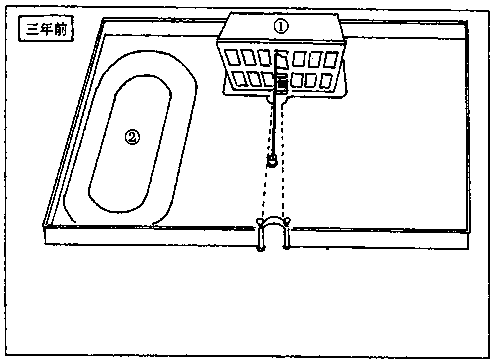
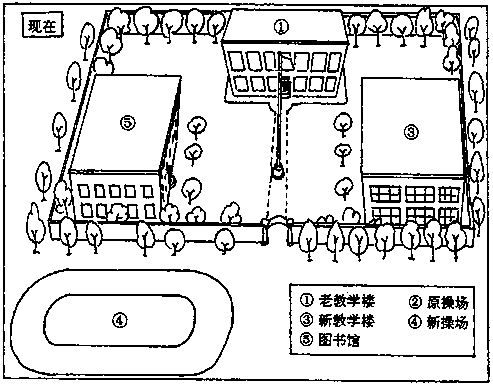
注意:
1.回信须包括图画的主要内容,可以适当增减细节,使内容连贯;
2.词数100左右。
July 9
Dear Mr Smith,
_________________________________________________________________________________________
_________________________________________________________________________________________
_________________________________________________________________________________________
_________________________________________________________________________________________
_________________________________________________________________________________________
Best wishes,
Yours,
Li Hua

 time arguing and there